


There is a lot of really helpful information out there about sensory diets, sensory breaks and regulation.
What type of sensory input your child needs. When they need it. What activities to try. How to help regulate them BEFORE they're completely overwhelmed.
I have read a lot of it.
I own a sensory-friendly clothing company.
I have two sensory kids.
You would think I have this down.
I do not.
I just took my first shower in two days because... kids. Enough said.
The reality is that I'm a busy mom. I'm working. I'm making dinner. Someone can't find something that is directly in front of them. Someone else is upset. I'm trying to remember the 47 things I was supposed to do today.
And somewhere in there I'm supposed to think, What type of sensory input does my child need right now?
Sometimes I can.
A lot of times, I can't.
Sensory Regulation Doesn't Have to Be Perfect
One of the biggest things I've learned as a sensory parent is that I need to make things EASY for myself.
I'm a big fan of creating little cheat sheets for life.
If something that helps my kids is buried in a drawer upstairs, there's a pretty good chance I'm going to forget it exists when we're in the middle of chaos downstairs.
So instead of trying to remember every sensory strategy I've ever learned, I started keeping useful sensory tools together.
One place. Easy to grab. Different options to try.
That's really the idea behind the two sensory kits I recently put together for Parker & Talia.
❤️ Val's Morning Hack
I keep sensory tools where the problem actually happens. If mornings are chaotic, the kit cannot live in a perfectly organized drawer upstairs. It needs to be somewhere I can grab it with one hand.
The Calm Kit: Sensory Tools for Big Feelings
Every kid is different, and even the same child may need something completely different from one day to the next.
That's why I didn't want the Calm Kit to contain just one type of sensory calming tool.
Inside are several different ways for a child to get sensory input or slow things down:
- A weighted comfort stuffie provides gentle weight and pressure and can be hugged, held or draped around the shoulders.
- A breathing necklace gives kids a physical tool to use while practicing slower, more intentional breathing.
- Stay Calm cards give them simple ideas to try when they're overwhelmed and don't know what to do next.
- A massage ball can be squeezed, rolled or used for tactile input.
- autism friendly socks with a seamless toe with a hand-finished seam, relocated approximately two inches below the toes and hand-linked to lay flat help take an irritating clothing sensation out of the equation.
- A matching scratch-and-sniff sticker adds scent as another sensory option.
And everything stays together in a reusable carrying case, because that's probably the most important part for me.

When things start going sideways, I don't want to search for six different things.
I want to say:
“Grab the Calm Kit.”
Done.
We can keep it at home, throw it in the car, bring it on vacation or take it somewhere I already know might be overwhelming.
❤️ What Worked for My Family
We stopped trying to make one tool work every time. Having a few different options together made it easier to try something without turning the moment into a full negotiation.
A Back-to-School Sensory Kit Kids Can Keep in Their Backpack
School brings a completely different set of sensory challenges.
New classrooms. Different routines. Lots of sitting. Lots of noise. Clothing that suddenly feels terrible at 7:42 AM when you needed to leave twelve minutes ago.
So I created a second grab-and-go kit specifically for school.
Our Back-to-School Sensory Kit includes:
- SmoothToe™ sensory-friendly socks
- A chewy necklace
- Pencil topper fidget
- Stretchy sensory fidget
- Sensory calming sticker
- Mini squishy
- Reusable zipper pouch
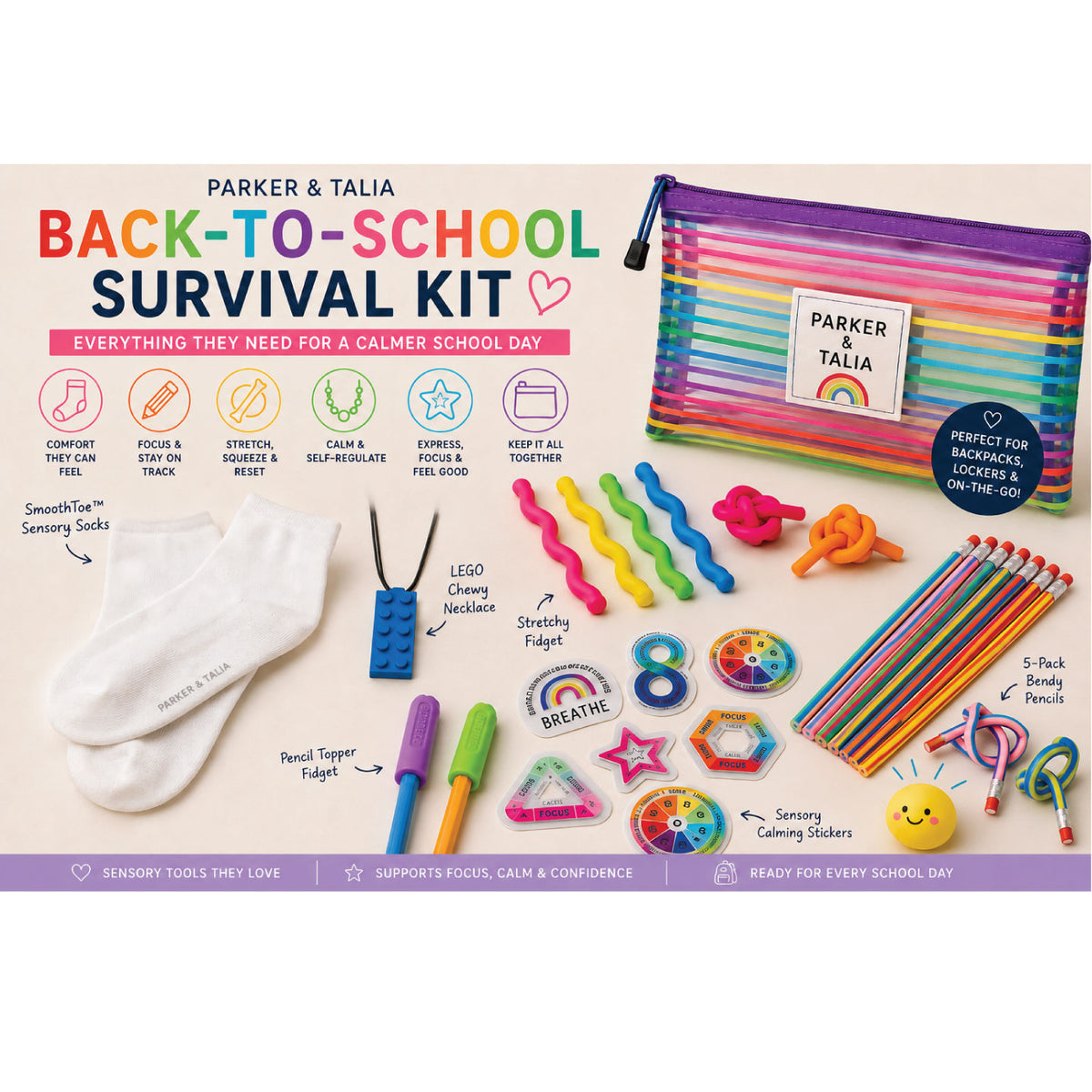
The idea is simple: give kids a few small, easy-to-use sensory tools that can stay together in their backpack, desk or locker.
Some kids need something to squeeze.
Some need something to chew.
Some need to keep their hands moving so the rest of their body can sit.
And some of our kids simply cannot think about math when the seam of their sock is staging a hostile takeover of their foot.
That is why I wanted this to be a practical sensory kit for kids: not another complicated routine that requires a color-coded schedule and a completely different version of me.
What Sensory Tools Should I Buy for My Child?
There isn't one sensory product that's going to work for every child.
That's actually the point.
Pay attention to what your child naturally seeks out or avoids. Do they chew their sleeves? Constantly move their hands? Love tight hugs or pressure? Get overwhelmed by certain textures? Seek certain smells?
Those little clues can help you figure out which sensory tools are worth trying.
And you don't need 75 sensory products.
Start small.
Try a few different types of sensory tools and see what your child actually reaches for.
The tool that looks perfect online may be the one your child ignores completely. The little squishy you almost left in the shopping cart may become the thing they carry everywhere. There is no perfect formula here.
The Goal Isn't Perfect Sensory Parenting
If you have a beautifully planned sensory routine and remember to proactively work regulation breaks into your child's entire day, I genuinely applaud you.
That is not and will never be me. 😂
I've learned to work with the mom I actually am instead of constantly trying to become some imaginary, extremely organized version of myself.
For me, that means putting the things that might help in one place where I can actually find them when we need them.
The Calm Kit and Back-to-School Sensory Kit are basically my latest sensory-parenting cheat sheets.
Nothing complicated.
Just useful tools, together, ready when life gets loud.
And sometimes, that's exactly what we need.
❤️ One Thing I Wish I Knew Sooner
A helpful sensory routine does not have to look impressive. If it makes one hard moment a little easier to manage, it is doing enough.