


There was a time when I thought my kids were just being really, really picky.
The socks were wrong.
The shirt was wrong.
The food they loved yesterday was suddenly disgusting today.
The bathroom hand dryer was apparently an instrument of torture.
And I would think the things I think a lot of parents think:
But you wore this yesterday.
You ate this last week.
It's not that loud.
It's just a sock.
Why is this SUCH a big deal?
If you're somewhere in this stage right now, wondering whether your child is being picky, stubborn, dramatic, difficult, or whether there is actually something sensory going on, I get it.
Because when you can't feel what your child is feeling, it can be incredibly hard to tell the difference.
And if you're trying to figure out whether you're seeing a pattern, I made a free 7-Day Sensory Pattern Tracker that you'll find farther down in this article.
Sensory issues don't always look the way you expect them to
Before I really understood sensory issues, I think I expected them to be obvious.
A child covers their ears because a sound is loud.
Okay. That makes sense.
But sensory sensitivities aren't always that neat.
A child might happily scream at the top of their lungs while playing and then completely lose it when someone turns on a hand dryer.
They might roll around barefoot in the grass but say the seam inside their sock hurts.
They might eat one brand of chicken nuggets but refuse another brand that looks virtually identical to you.
They might love getting messy with paint but hate having sunscreen rubbed onto their skin.
They may tolerate a crowded playground one day and be completely overwhelmed by it another day.
And that's where parents start wondering:
Is this actually sensory? Or are they just being picky?
Sometimes they're being picky.
Kids are allowed to have preferences just like the rest of us.
But sometimes what looks like a preference from the outside feels completely different inside their body.
“I don't like it” and “I can't tolerate it” can look very similar
This was one of the hardest things for me to understand.
Especially when my kids were younger.
A little kid doesn't usually come to you and say:
“Mother, I'm experiencing significant tactile discomfort from the elastic tension around my ankle.”
They say:
I HATE THESE SOCKS.
Or they rip them off.
Or cry.
Or refuse to put their shoes on.
Or suddenly they're lying on the floor and you're looking at the clock because you needed to leave eight minutes ago.
The behavior is what we see.
The sensation underneath it is much harder to see.
So instead of only looking at what my child was refusing, I eventually started paying much more attention to how they were reacting to it.
Here are the things I started noticing
There isn't one magical test that tells you, “Yep, definitely sensory.”
And I'm certainly not suggesting that a parent can diagnose their child from a blog post.
But patterns can tell us a lot.
Does the same type of thing keep happening?
One sock complaint isn't necessarily a sensory issue.
But what about socks, tights, tags, waistbands, jeans and certain fabrics?
One loud toilet might scare any kid.
But what about toilets, hand dryers, vacuum cleaners, birthday parties and the school cafeteria?
One rejected dinner?
Welcome to having children.
But if your child consistently struggles with certain textures, smells, temperatures, mixed foods or brands, that's worth noticing.
I stopped looking at each incident as its own random problem and started looking for patterns.
That was a huge shift for me.
Is the reaction much bigger than you'd expect from a simple preference?
There's a difference between:
“I don't like these pants.”
and
“GET THEM OFF ME.”
Sensory discomfort can sometimes create a very physical response.
You might see your child pulling clothes away from their skin, covering their ears, gagging, rubbing at something, freezing, running away, becoming frantic or completely melting down.
What looks completely disproportionate to us may not feel disproportionate to them.
If your brain is telling you a sock feels mildly annoying but your child's nervous system is screaming GET THIS THING OFF MY BODY, you are having two completely different experiences with the exact same sock.
And only one of you is wearing it.
Does explaining why it “shouldn't” bother them accomplish absolutely nothing?
This one took me a while.
There's nothing there.
It's not itchy.
That noise isn't even loud.
It's the exact same food.
You wore this yesterday!
I have personally presented all of these extremely convincing legal arguments.
My children remained unmoved.
Because you can't really reason someone out of a physical sensation.
If something feels unbearably scratchy to your child, telling them that it isn't scratchy doesn't change what their skin is telling their brain.
And this was hard for me because I couldn't feel it.
I had to learn to believe something was uncomfortable even when it wouldn't have been uncomfortable to me.
One of my biggest clues was what happened when I removed the problem
This is something I wish I had paid attention to much earlier.
Imagine your child is falling apart while getting dressed.
They're refusing.
They're crying.
They're angry.
They're not cooperating.
It looks behavioral.
Then you take off the shirt they've been fighting about and hand them their old, soft, ridiculously over-washed favorite shirt.
They put it on.
And suddenly...
They're fine.
Same kid.
Same morning.
Same expectation that they need to get dressed.
Different clothing.
That's information.
It doesn't automatically mean your child has a sensory processing issue.
But it does make me curious.
What changed?
Sometimes instead of asking, “How do I get them to stop doing this?” it helps to ask:
“What is their body trying to tell me?”
Socks were the thing that finally made this impossible for me to ignore
My daughter went almost an entire year without wearing socks.
Not “she complained about socks.”
She basically stopped wearing them.
She would wear rain boots with bare feet rather than put socks on.
And if you've never had a child with a serious sock issue, that probably sounds completely absurd.
I know.
They're socks.
Except to her, they weren't just socks.
There was the seam across the toes.
There was bunching.
There was fabric against her skin.
There was elastic around her leg.
There was the feeling of the sock inside the shoe.
All these tiny sensations I could barely notice were sensations she couldn't stop noticing.
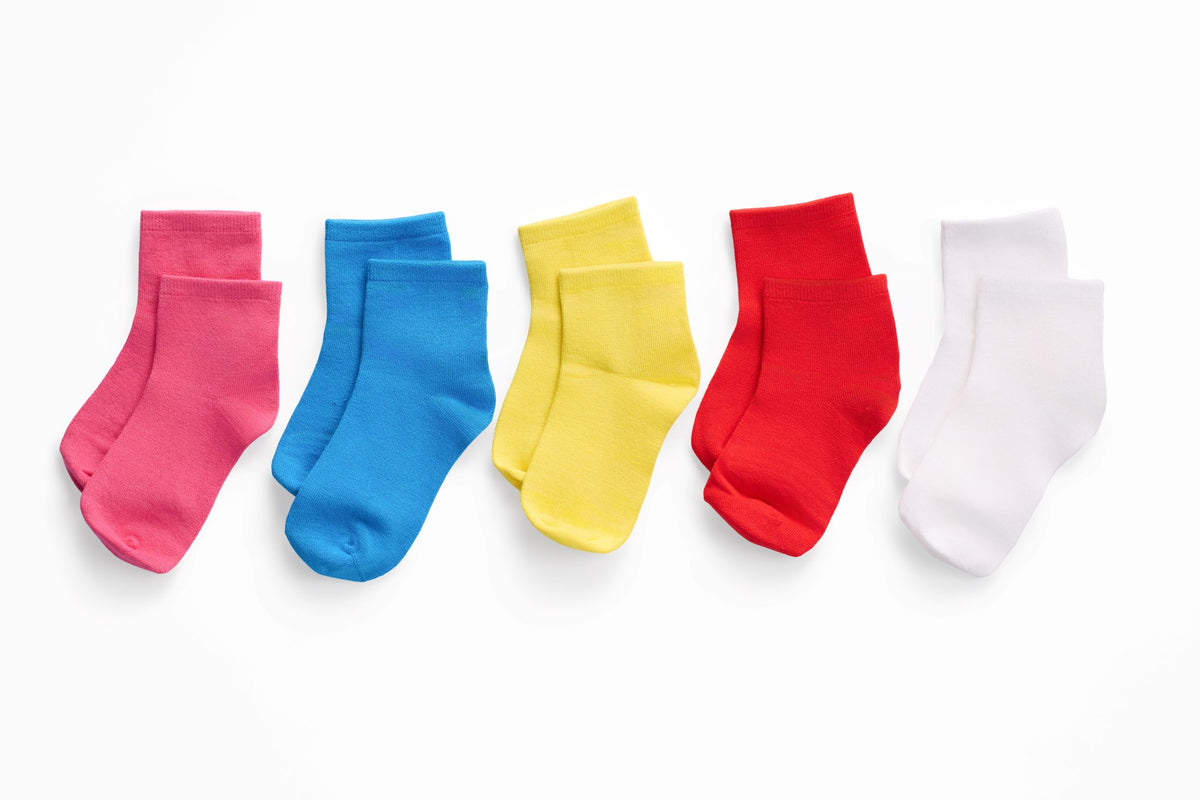
Eventually I stopped trying to convince her that socks shouldn't bother her and started trying to understand what about socks bothered her.
That question ultimately changed my career.
I'm a fashion designer, so once I understood the problem differently, I started looking at the sock differently too.
Instead of thinking, “How do I get my daughter to wear this?”
I started thinking:
“Why are socks made this way in the first place?”
That eventually led me to redesign them for her, and later to start Parker & Talia.
But long before there was a company, there was just a mom staring at a barefoot kid in rain boots thinking:
There has GOT to be a better way to do this.
Food can be especially confusing
This is where “picky” gets really complicated.
Your child ate the strawberries yesterday.
Today the strawberries are unacceptable.
What happened?!
Well... yesterday's strawberry may have been firm and sweet.
Today's might be softer.
Or colder.
Or mushier.
Or smell different.
Or have seeds that feel more noticeable.
Processed foods tend to be incredibly predictable. A cracker from the box usually tastes and feels exactly like the cracker before it.
A blueberry is basically playing roulette.
Some are sweet.
Some are sour.
Some pop.
Some are mushy little traitors.
So a child who craves predictability may seem irrationally loyal to particular foods or brands when what they're actually choosing is consistency.
That doesn't mean every food preference is sensory.
It means there may be more happening than “my kid refuses to eat anything.”
And sensory needs can change from day to day
This one can make parents feel like they're losing their minds.
BUT YOU WERE FINE WITH THIS YESTERDAY.
Yep.
And they may genuinely not be fine with it today.
Think about your own tolerance.
A noise that wouldn't normally bother you can make you want to crawl out of your skin when you're exhausted.
A waistband you normally don't notice suddenly feels awful when you're bloated.
Someone touching you can feel comforting when you're relaxed and irritating when you've had an absolutely terrible day.
Our tolerance changes.
Kids' tolerance can too.
School, lack of sleep, hunger, illness, anxiety, excitement, transitions and simply having had a very demanding day can all affect how much more input a child can handle.
So “they tolerated it yesterday” isn't always proof that they're choosing not to tolerate it today.
So... when should you pay more attention?
If you're wondering whether something might be sensory rather than simply a preference, start noticing instead of immediately trying to fix it.
Keep an eye on:
- whether the same types of triggers happen repeatedly
- whether the reaction seems physical or unusually intense
- whether your child avoids certain textures, sounds, smells, tastes or sensations
- whether removing the suspected trigger changes their behavior
- whether these reactions interfere with getting dressed, eating, sleeping, school, leaving the house or everyday family life
You don't need to figure everything out yourself.
If sensory challenges are significantly affecting your child's daily life, it's worth talking with your pediatrician or an occupational therapist who can help you understand what may be happening.
But you can start collecting information long before that appointment.
I made a free 7-Day Sensory Pattern Tracker to help you notice those patterns without having to rely on memory in the middle of a busy week.
Because you know your child.
You see what happens before the meltdown.
You know which shirt always comes off.
Which bathroom they refuse to enter.
Which foods make them gag.
Which sounds send their hands straight over their ears.
Those little details matter.
The question I wish I had asked sooner
For a long time, when one of my kids had a huge reaction to something that seemed incredibly small, my brain went straight to:
Why are they being so difficult about this?
Now I try to ask:
What about this might be difficult for them?
Sometimes the answer really is:
Nothing. They just don't like it.
Kids are still kids.
Sensory issues don't mean every “no” needs to become a “yes, absolutely, whatever you want.”
But sometimes there is something happening underneath the behavior that we can't see.
And getting curious about it can completely change the way you respond.
Your child may not have the words yet to tell you:
The lights feel too bright.
That smell makes me feel sick.
The waistband feels like it's squeezing me.
That noise hurts.
The sock seam is all I can think about.
So they communicate it the only way they know how.
And sometimes the first step isn't getting them to stop.
It's figuring out what they're trying to tell us.